The 2026 FIFA World Cup begins on June 11 with the opening match between Mexico and South Africa.
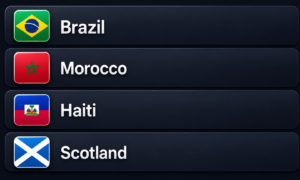
Attention then turns to the group stage, where Group C brings together four sides at very different points in their footballing trajectory: Brazil, Morocco, Scotland and Haiti.
Group C overview
- Brazil – 5-time world champions, ranked 6th globally
- Morocco – 2022 semi-finalists, ranked 8th
- Scotland – returning for first World Cup since 1998, ranked 43rd
- Haiti – second World Cup appearance, ranked 83rd
Brazil
Brazil remains the most successful nation in World Cup history, with five titles and a record of appearing at every edition of the tournament.
However, their recent form has been less convincing by their own standards, and expectations heading into 2026 are more measured than in previous decades.
Qualification
Brazil’s qualifying campaign in South America was inconsistent. After a strong start, results dipped significantly, including a heavy defeat to Argentina. That run led to a coaching change, with Dorival Júnior replaced by Carlo Ancelotti.
Under Ancelotti, results improved late in qualification, and Brazil secured their place at the tournament.
Key player
Vinícius Júnior is expected to lead the attack. While highly regarded at club level, his international influence is still developing.
Overview
Brazil still possesses individual quality, but the overall balance and consistency of the squad have been questioned in recent campaigns.
Morocco
Morocco have established themselves as one of the most tactically disciplined teams in international football following their historic run to the 2022 semi-finals.
Qualification
They produced a flawless qualifying campaign, winning all of their matches and conceding very few goals. Their early qualification reflected their consistency and organization.
Key player
Achraf Hakimi remains their most influential figure, contributing both defensively and in attack.
Overview
Morocco’s strength lies in structure, organization, and team cohesion, making them difficult to break down and consistently competitive in tournament settings.
Scotland
Scotland returned to the World Cup for the first time in 28 years, having last appeared in 1998.
They have competed at eight World Cups but have never progressed beyond the group stage.
Qualification
Their qualifying campaign included key wins, most notably a decisive result against Denmark, which helped secure their place at the tournament. Their only defeat came against Greece.
Key player
Scott McTominay has become central to the team’s midfield, contributing energy, goals, and leadership.
Overview
Scotland relies on intensity and collective organization. While not among the favorites in the group, they arrive with confidence after ending a long absence.
Haiti
Haiti will compete in only their second World Cup, and their first since 1974.
Their return marks a rare appearance on the global stage after decades away from the competition.
Qualification
Haiti progressed through CONCACAF qualifying, finishing strongly to secure their place in the final phase.
Key player
Wilson Isidor provides their main attacking threat and a focal point in forward positions.
Overview
Haiti are expected to rely on defensive structure and counter-attacking opportunities against stronger opposition.
Group outlook
Group C features a wide gap in experience and expectation, with Brazil and Morocco seen as the most established sides, while Scotland and Haiti aim to disrupt the hierarchy in different ways.
Brazil’s consistency remains under scrutiny, Morocco brings stability and structure, Scotland offers physical intensity after a long absence, and Haiti enters as a clear outsider.
The group is likely to be shaped by how effectively the favorites manage pressure and whether the underdogs can take advantage of any inconsistency.