


The offside law is one of the most important regulations in football. It was created to ensure fairness in the game and to prevent attacking players from exploiting weaknesses in the defensive line by positioning themselves too close to the opponent’s goal. Despite its vital role, this law often becomes a source of controversy due to its complexity and the difficulty of interpretation in real match situations.
This article from 7mcn offers a thorough explanation of the offside law, from its definition and linguistic origin to the methods used to determine an offside offense, common scenarios in matches, and the role of modern technology in supporting referees’ decisions.
What is the offside law?
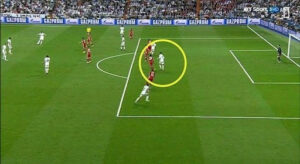
In football discussions, many people still confuse terms such as “liệt vị,” “thiệt vị,” and “việt vị” when referring to positional rules on the pitch. Due to similarities in pronunciation, these terms can be misleading. However, the only correct and officially recognized term is “việt vị,” which translates to “offside” in English.
According to the Vietnamese dictionary edited by Hoàng Phê in 1992, “việt vị” refers to a situation in which a football player receives the ball to attack in the opponent’s half while fewer than two opposing players are positioned between him and the goal line. This typically happens when an attacker receives the ball close to the opponent’s goal with only the goalkeeper in front of him and no other defenders in between.
In simpler terms, an offside situation occurs when an attacking player positions himself too advantageously compared to the defensive line at the moment a teammate passes the ball. This creates an unfair scoring opportunity, which is why the offside law exists to maintain balance and fairness in the game.
From a linguistic perspective, “việt vị” originates from Sino-Vietnamese roots. The word “việt” means to go beyond or surpass, while “vị” refers to position or place. Combined, the term implies exceeding the permitted position. In English, the equivalent term is “offside,” which describes a player being beyond the legally allowed position during an attacking phase.
The purpose and significance of the offside law
The offside law is not merely a technical rule but a fundamental element that shapes modern football tactics. Without it, attackers could simply remain near the opponent’s goal, waiting for long passes, which would reduce competitiveness and diminish the strategic depth of the sport.
Thanks to the offside law, teams must develop more sophisticated attacking patterns that emphasize movement, timing, and coordination. Defenders, on the other hand, can organize the defensive line and use offside traps as a tactical weapon. As a result, the offside rule contributes significantly to the tactical beauty and intellectual challenge of football.
How to determine an offside offense
To identify an offside offense, the laws of the game issued by FIFA clearly define several key principles. A player is considered to be in an offside position if he is in the opponent’s half of the field and, at the moment the ball is passed by a teammate, there are fewer than two opposing players between him and the goal line, usually including the goalkeeper.
However, being in an offside position does not automatically mean an offense has occurred. A player is only penalized for offside if he becomes actively involved in play. Active involvement includes attempting to play or receive the ball, challenging an opponent for possession, obstructing the goalkeeper’s line of sight, or otherwise influencing the opponent’s ability to defend.
If a player is in an offside position but makes no attempt to interfere with play or gain an advantage from that position, he will not be penalized. This distinction between being “in an offside position” and “committing an offside offense” is one of the main reasons why the rule is often misunderstood.
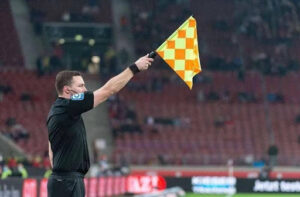
When an offside offense is identified, the assistant referee usually signals by raising the flag. The main referee then stops play and awards an indirect free kick to the defending team at the location where the offside offense occurred.
The role of referees and technology in offside decisions
Modern football is played at an increasingly high tempo, with rapid transitions and split-second actions. This makes it extremely challenging for referees and assistant referees to accurately judge offside situations, especially when the difference between onside and offside can be just a few centimeters.
To address these challenges, the VAR system has been introduced to assist officials in reviewing controversial situations, including offside decisions. VAR allows referees to analyze replays from multiple camera angles and use digital lines to precisely determine a player’s position at the exact moment the ball is played.
Thanks to VAR, many incorrect decisions have been corrected, improving fairness and accuracy in the game. However, this technology has also sparked debate, as some fans believe that overly precise measurements reduce the emotional spontaneity of football, while others appreciate the increased objectivity it provides.
For fans who regularly follow match analysis and live updates, detailed explanations of offside situations can also be found through football information platforms such as https://7mcn.london/, which help viewers better understand referees’ decisions during matches.
Common offside situations in football

The offside law includes specific scenarios to ensure consistent application across all matches. Below are the most common situations related to offside that football fans should be familiar with.
Case 1: Offside offense
A player is considered to have committed an offside offense when two conditions are met simultaneously. First, the player must touch or receive the ball from a teammate while in an offside position. Second, he must actively participate in the play.
Active participation can take several forms, such as challenging a defender for the ball, obstructing the goalkeeper’s vision, moving toward the ball to receive it, or deliberately exploiting the offside position to create a scoring chance. In these cases, the referee will penalize the offense, and any resulting goal will be disallowed.
It is important to note that if a player is in an offside position but does not interfere with play in any way, he will not be punished. This clarification is crucial for understanding many controversial decisions.
Case 2: No offside offense
There are also situations in which a player is not considered offside, even if his position appears questionable. A player cannot be offside if he is in his own half of the field at the moment the ball is played.
Additionally, a player is not offside if he is level with the second-last defender or level with the last two opponents. This requires assistant referees to carefully align their viewpoint with the defensive line to make accurate judgments.
Furthermore, the offside law does not apply in certain restart situations, including throw-ins, corner kicks, and goal kicks. In these cases, attackers are free to position themselves anywhere on the pitch and still legally receive the ball.
Controversies surrounding the offside law
Despite its intention to promote fairness, the offside law has been at the center of countless controversies throughout football history. Many high-profile matches have been influenced by disputed offside calls, especially when the margin between offside and onside is extremely small.
The introduction of VAR has reduced some of these controversies, but it has also created new debates. Some argue that microscopic offside decisions undermine the spirit of the game, while others believe that accuracy and fairness should always take priority.
Conclusion
The offside law plays a crucial role in maintaining balance between attack and defense, ensuring fairness, and preserving the tactical depth of football. Although it continues to generate debate, there is no denying its importance in the modern game.
This in-depth article from 7MCN aims to provide readers with a clear and comprehensive understanding of the offside law, its application, and its implications. With this knowledge, fans can better appreciate the decisions made by referees and enjoy football with a more informed perspective.