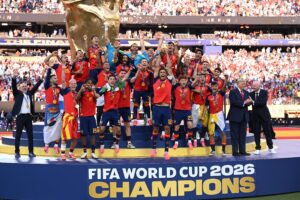
Torres Writes His Name Into History
Spain are world champions again. A dramatic 1-0 extra-time win over Argentina at MetLife Stadium sealed the nation’s second World Cup crown. Substitute Ferran Torres struck the decisive blow, latching onto a clever header from Nico Williams before finishing coolly past Emiliano Martínez.
The goal carries weight beyond the scoreline. Torres became only the fifth substitute ever to score in a World Cup final. Not since Mario Götze’s iconic 2014 winner against this same opponent has a player entered so decisively from the bench on football’s biggest stage.
For ninety minutes, Argentina had matched Spain blow for blow. Their captain Lionel Messi, playing what many believe was his final World Cup match, searched tirelessly for one last moment of magic. It never quite arrived. Meanwhile, the excellent Pau Cubarsí continued his remarkable tournament, marshalling Spain’s defence with composure well beyond his years.
Everything changed in the 90th minute, however. A reckless challenge from Enzo Fernández on Cubarsí earned him a second yellow card. Argentina were reduced to ten men just as extra time loomed. Suddenly, the numerical disadvantage told.
Spain pressed relentlessly afterward, and the breakthrough came early in the second period of extra time. Still, Argentina refused to fold completely. Late drama followed: Cubarsí produced a vital clearance to deny a likely equaliser, and Giuliano Simeone then blazed a golden chance over the crossbar moments later.
Fans searching for more tactical breakdowns of the tournament can explore further analysis on the KCPredict blog, where the road to this final has been tracked in detail.
Records Tumble as Spain Reach the Summit
This triumph places Spain among football’s true elite once more. Their first World Cup arrived in 2010, also settled 1-0 in extra time, against the Netherlands. Sixteen years later, history repeated itself in eerily similar fashion.
Remarkably, Spain now sit unbeaten across 38 consecutive matches in all competitions. That stretch represents the longest such run by any European nation in the sport’s history. Consistency, not just individual brilliance, has defined this Spanish generation.
Argentina, by contrast, leave the tournament without back-to-back titles. Not since Brazil in 1962 has a nation retained the World Cup, and Lionel Scaloni’s side could not rewrite that script. Despite Messi’s enduring influence, the South Americans struggled to create clear-cut chances throughout the final.
Individual Honours Round Out a Historic Tournament
Personal accolades followed the final whistle. Rodri claimed the Golden Ball, edging out Messi himself for the tournament’s top individual prize. Pau Cubarsí, only a teenager, took home the Best Young Player award after a string of assured performances. Unai Simón, Spain’s dependable goalkeeper, collected the Golden Glove.
Elsewhere, Kylian Mbappé finished the tournament with ten goals, more than enough to secure the Golden Boot outright. The Netherlands, meanwhile, were recognised for their conduct throughout the competition, taking home the FIFA Fair Play Award.
According to ESPN’s coverage of the final, the match was played in front of a raucous crowd at MetLife Stadium in New Jersey, a fitting stage for football’s grandest occasion. As celebrations continue across Spain, attention will soon turn to how this golden generation builds on their latest triumph.