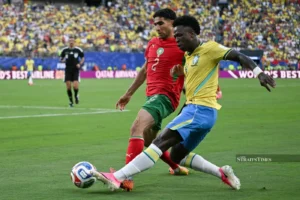
The Favorites Stumble: Morocco Steals Respect in New Jersey
Brazil entered MetLife Stadium as tournament favorites. Five-time champions. Global elite. One of the tournament’s genuine powerhouses. Pre-match projections gave them a 57.7 percent chance of victory. Morocco managed just 18.8 percent. The draw probability sat at 23.5 percent. Favorites rarely exit their opening matches disappointed. Brazil seemed destined to control, conquer, and advance.
Yet football refuses to follow algorithmic predictions. Morocco, the rising African power, silenced the statistical noise with brilliant football and ruthless execution. The Atlas Lions took the lead through Ismael Saibari’s clinical counterattack. They pressed Brazil relentlessly. They controlled possession. They dictated rhythm.
Vinícius Júnior equalized brilliantly, cutting inside and finishing with accuracy. The Brazilian winger’s strike offered hope of dominance resuming. Yet Morocco held firm. They absorbed pressure. They stayed organized. They refused to yield to a team carrying five World Cup trophies.
The final whistle blew with the scoreboard showing 1-1. A draw at MetLife Stadium. One of the tournament’s biggest opening fixtures finished in stalemate. Brazil departed New Jersey with one point instead of the three they anticipated. Morocco left with something more valuable than mathematics: validation.
This result reshapes Group C entirely. Brazil cannot afford further points surrendered against Scotland or Haiti. Morocco proved they belong at football’s grandest stage. They showed that five-time champions remain mortal. They demonstrated that African football has genuinely evolved into something dangerous.
For Ancelotti’s Brazil, this represented a missed opportunity. The manager fielded his strongest available XI. Vinicius led the attack. The midfield controlled possession. Yet organized opposition proved overwhelming. Sometimes defense beats attack.
Morocco’s First Half Masterclass
Morocco attacked the opening period like a team with nothing to lose and everything to prove. They pressed Brazil from the kickoff. They harassed the ball carrier. They forced errors. They created space through relentless intensity. This was not cautious African football. This was aggressive, confident, and thoroughly modern.
Ismael Saibari finished their breakthrough with clinical composure. A counterattack broke down Brazil’s defense. Saibari found space. He composed himself. One touch. One finish. Perfect execution under maximum pressure. The goal announced something significant. Morocco would not accept a passive role. They would compete directly with tournament favorites.
Brazil’s midfield looked overwhelmed initially. The Brazilian side expected to control possession and dictate proceedings instead found themselves constantly harassed. Morocco’s pressing prevented Brazil from establishing rhythm. The five-time champions struggled to execute their natural patterns. The quality supposed to overwhelm the opposition proved not enough against organized opposition.
Casemiro and Rodrygo tried to impose themselves. Vinicius searched for space on the flank. Yet Morocco’s defensive shape remained compact. Their pressing remained intelligent. They knew when to squeeze. They understood where to block passing lanes. The atlas lions had studied Brazil carefully and executed their game plan brilliantly.
By halftime, Brazil encountered an uncomfortable reality. They were losing to Morocco. They needed to improve significantly. They required adjustments. The second half would determine whether the favorites could respond or whether Morocco’s plan remained operational.
Brazil’s Adjustments: The Equalizer Arrives
The second half opened with Ancelotti making tactical changes. Fresh legs entered the pitch. Brazil shifted their approach. More direct. More attacking. Less possession-oriented. The fundamental philosophy shifted from control to effectiveness.
Vinicius Júnior provided the response. The Brazilian winger cut inside from the left flank, found space in the crowded penalty area, and finished clinically past the goalkeeper. His goal equalized the match immediately. Brazil had answered Morocco’s challenge. The favorites had found their moment. Equilibrium returned to the scoreboard.
Yet momentum stayed elusive. Both teams seemed exhausted after intense first-half battle. Morocco kept possession but created little. Brazil pressed but generated limited clear-cut opportunities. The second half developed into a tense stalemate. Possession exchanges hands repeatedly. Neither side truly threatened the goalkeeper.
Substitutions arrived from both benches. Fabinho replaced Casemiro. Danilo came on for a defender. Morocco made their own changes. Yet the tactical state remained unchanged. Brazil could not find a breakthrough. Morocco refused to crack. The match moved toward conclusion with neither side able to force victory.
Group C Transforms: Three Teams Level
This result completely alters Group C dynamics. Brazil cannot maintain their historic unbeaten streak in World Cup openers. The five-time champions drew instead of winning. Morocco proved they compete with elite opposition. Scotland, Haiti, and whoever finishes second will see possibilities where none existed before.
Group C just became football’s most unpredictable stage. Three teams now share the points. Brazil encounters pressure immediately in subsequent fixtures. Morocco built momentum despite not winning. The group remains genuinely open.