


The 2026 FIFA World Cup begins on June 11, when co-hosts Mexico face South Africa in the opening match.
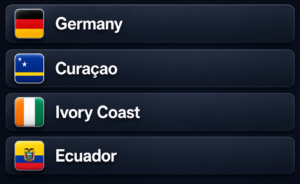
Attention then turns to Group E, which brings together four teams at very different stages of development: Germany, Ecuador, Ivory Coast, and Curaçao.
The group includes a former world champion looking to re-establish itself, two ambitious emerging sides, and a debutant nation making history.
Group E overview
- Germany – four-time world champions, ranked 10th
- Ecuador – consistent South American qualifier, ranked 23rd
- Ivory Coast – African champions, ranked 34th
- Curaçao – World Cup debutants, ranked 82nd
CURACAO
Tournament profile
Curacao made history as the smallest nation by population to qualify for a FIFA World Cup. This marks their first appearance at the tournament.
Veteran manager Dick Advocaat leads the side, becoming the oldest manager in World Cup history in the process.
Qualification journey
Curaçao qualified without defeat, producing a strong run through CONCACAF qualifying.
They won all four matches in the second phase, including victories over Barbados, Aruba, Saint Lucia, and Haiti.
In the final round, they remained unbeaten across six matches, securing qualification with a goalless draw in Jamaica.
Key player
Juninho Bacuna provides creativity and experience in midfield, supported by his brother and the team’s captain, Leandro Bacuna.
He brings extensive experience in English football and is one of the team’s most established international performers.
Tactical outlook
Curaçao relies on organization, discipline, and compact defensive structure, with limited possession expected against stronger opponents.
Assessment
This is a landmark tournament for Curaçao, with the primary objectives of delivering competitive performances and gaining experience at the elite level.
ECUADOR
Tournament profile
Ecuador return for their second consecutive World Cup and fifth appearance since 2002.
They have a strong record of winning at least one match in every World Cup they have played.
Qualification journey
Ecuador finished second in South American qualifying, behind Argentina, in a campaign defined by defensive organization.
They conceded only five goals across 18 matches, one of the best defensive records in the region.
However, their attack remained limited, with 14 goals scored during qualifying.
They also carried a long unbeaten run into the tournament cycle, stretching over multiple competitive fixtures.
Key player
Moises Caicedo is the central figure in midfield, providing defensive control, ball recovery, and regulation of tempo.
His importance to Ecuador’s structure is significant, particularly in matches against higher-ranked opponents.
Tactical outlook
Ecuador are built around defensive stability and a compact structure, with an emphasis on limiting opponents’ chances rather than on high-scoring football.
Their main concern remains attacking efficiency, with veteran forward Enner Valencia still a key reference point.
Assessment
A disciplined side capable of frustrating opponents, but progression will depend on improving attacking output.
GERMANY
Tournament profile
Germany are four-time world champions and one of the most successful teams in World Cup history.
They arrive in 2026 aiming to move past disappointing recent tournaments and re-establish themselves among the elite.
Qualification journey
Germany began qualifying with an unexpected defeat to Slovakia but recovered strongly.
They won their final five matches, including a dominant 6–0 win in the return fixture against Slovakia.
Their goals were spread across multiple players, reflecting a collective attacking contribution rather than reliance on one scorer.
However, they will be without Serge Gnabry due to injury.
Key player
Florian Wirtz is the creative centerpiece of the team, operating across multiple attacking roles.
He has become increasingly influential for Germany, contributing both goals and assists in recent international competitions.
Alongside him, Joshua Kimmich provides leadership and structure from midfield.
Tactical outlook
Under Julian Nagelsmann, Germany have developed into a more fluid and aggressive side, blending youth and experience.
They have added attacking flexibility but are still searching for a consistent profile for a central striker.
Assessment
Germany enters as group favorites, with expectations to progress comfortably while continuing their rebuild.
IVORY COAST
Tournament profile
Ivory Coast return to the World Cup for the first time in 12 years, following their last appearance in 2014.
They are African champions and carry one of the strongest squads from the continent.
Qualification journey
Ivory Coast produced a dominant qualifying campaign, winning eight of ten matches.
Remarkably, they conceded no goals during qualification and finished top of their group, narrowly ahead of Gabon.
Key player
Franck Kessié leads the team from midfield, providing experience, physical presence, and leadership.
He is one of the most consistent figures in the squad and a central reference point in both phases of play.
Tactical outlook
Ivory Coast combines physical strength with technical ability, supported by a deep squad featuring players across Europe’s top leagues.
Their defensive record in qualifying underlines their organization and discipline.
Assessment
A strong contender for knockout qualification, with depth and balance across the squad.
GROUP OUTLOOK
Group E features a clear contrast in experience levels but strong competition behind the favorites.
Germany carries the highest pedigree and is expected to top the group. Ecuador and the Ivory Coast are closely matched behind them, with both capable of securing qualification depending on key results. Curacao enters as debutants, aiming to gain experience and remain competitive.
The group is likely to be shaped by defensive organization, with multiple sides prioritizing structure over open play.