


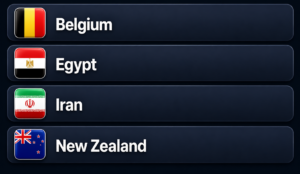
Attention then turns to Group G, a section defined by experience, star power, and contrasting trajectories, featuring Belgium, Egypt, Iran, and New Zealand. Belgium arrives as the most decorated side in the group, Egypt carries the weight of Mohamed Salah’s legacy, Iran enters amid off-field uncertainty, while New Zealand looks to defy expectations as the lowest-ranked side.
Group G overview
- Belgium – third place finish in 2018, ranked 9th
- Egypt – historic African side led by Mohamed Salah, ranked 29th
- Iran – consistent Asian qualifier, ranked 21st
- New Zealand – Oceania representatives, ranked 85th
BELGIUM
Tournament profile
Belgium arrive at another World Cup as one of Europe’s most experienced international sides, though this tournament feels like a final chapter for their long-standing core.
Their so-called “golden generation” has delivered consistent qualification campaigns but has often fallen short in major tournaments relative to expectation.
Qualification journey
Belgium secured qualification from Europe comfortably, going unbeaten in their group with five wins and three draws.
Despite a controlled campaign, a late draw against Mexico highlighted that consistency will need to translate into knockout-stage intensity.
Key player
Thibaut Courtois remains Belgium’s most decisive figure.
The Real Madrid goalkeeper brings elite-level experience and shot-stopping ability, and at 34 this may represent one of his final major tournaments with the national team.
Alongside him, Belgium still rely heavily on established names such as Kevin De Bruyne and Romelu Lukaku, with Jeremy Doku offering pace and unpredictability in attack.
Tactical outlook
Belgium are transitioning between generations, balancing experience with emerging attacking talent.
Their success will depend heavily on whether their senior core can maintain performance levels against younger, more dynamic opposition.
Assessment
Belgium should progress from the group, but questions remain about how far this squad can go once they face elite opposition in the knockout stages.
EGYPT
Tournament profile
Egypt returns to the World Cup with one of Africa’s most recognizable footballing figures leading them.
Despite a strong continental pedigree, they are still searching for their first-ever victory at a World Cup finals.
Qualification journey
Egypt enjoyed a dominant qualifying campaign, finishing top of their group with eight wins and two draws.
They conceded only two goals, demonstrating strong defensive organization throughout the campaign.
Mohamed Salah was again central to their success, scoring regularly to guide them through qualification.
Key player
Mohamed Salah remains the defining figure of Egyptian football.
The Liverpool forward, and now national captain, carries enormous expectation as he enters what could be his final World Cup cycle.
He will be supported by Omar Marmoush, who adds pace and direct attacking threat from wide areas.
Tactical outlook
Egypt are built around defensive structure and transition play, relying heavily on Salah’s ability to decide tight matches.
Their challenge remains converting defensive stability into consistent attacking output at elite level.
Assessment
Egypt have the quality to challenge for qualification, but consistency in front of goal will determine whether they progress beyond the group stage.
IRAN
Tournament profile
Iran returns for their seventh World Cup amid significant external uncertainty, with off-field geopolitical tensions forming part of the wider backdrop to their participation.
Despite this, they remain one of Asia’s most consistent qualifiers in recent years.
Qualification journey
Iran topped their Asian qualifying group, losing just once across ten matches.
Their campaign was built on efficiency, structure, and strong defensive organization.
Mehdi Taremi once again led the line effectively, continuing his long-standing role as their primary attacking outlet.
Key player
Mehdi Taremi remains Iran’s key attacking figure.
The experienced forward has a strong international scoring record and provides both goals and link-up play, often dropping deep to connect midfield and attack.
His ability to convert limited chances will be crucial in a tight group.
Tactical outlook
Iran are typically compact and disciplined, focusing on defensive organization and structured counter-attacks.
Much of their success depends on controlling low-margin matches and maximizing set-piece opportunities.
Assessment
Iran’s path to the knockout stage is uncertain, but their organization and experience make them competitive in a closely contested group.
NEW ZEALAND
Tournament profile
New Zealand returns to the World Cup for the first time since 2010 and only the third time in their history.
They remain the lowest-ranked side in Group G but arrive with confidence after dominant regional qualification.
Qualification journey
New Zealand cruised through Oceania qualifying, conceding just once across the entire campaign.
Their qualification process was the most straightforward in the group, underlining their regional dominance.
Key player
Chris Wood leads the line as captain and all-time top scorer.
The Nottingham Forest striker brings Premier League experience and serves as the focal point of New Zealand’s attack.
Much of their offensive output is expected to rely on his finishing ability and aerial strength.
Tactical outlook
New Zealand are expected to play direct, structured football, often relying on physical duels and long-ball transitions.
Their ability to compete physically will be key against higher-ranked opposition.
Assessment
New Zealand will likely find the group stage challenging but remain capable of competing closely in individual matches, particularly if they can capitalize on limited chances.
GROUP OUTLOOK
Group G blends elite experience with uncertainty and opportunity.
Belgium remains the most established side, but questions linger about their generational transition. Egypt relies heavily on Mohamed Salah’s influence, Iran brings tactical discipline but faces external pressures, and New Zealand enters as underdogs seeking to disrupt expectations.
With no dominant favorite, the group is expected to be tightly contested, with small margins likely deciding qualification places.