


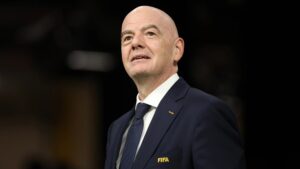
Football’s power brokers are moving decisively against Gianni Infantino, with UEFA now exploring formal mechanisms to remove him from FIFA’s presidency. The escalating campaign marks the most serious threat yet to his decade-long grip on the role.
Crisis Deepens After Salzburg Talks
Tensions boiled over following the collapse of FIFA’s controversial plan to sell World Cup broadcasting rights to private equity investors. That failed initiative triggered widespread anger among senior football administrators, effectively igniting what insiders now describe as open civil war within the game’s governance structures.
UEFA president Aleksander Ceferin convened crucial meetings in Salzburg this week, using the UEFA Super Cup as cover for high-stakes diplomacy. Nasser Al Khelaifi, chairman of the European Club Association and president of Paris Saint-Germain, joined discussions alongside Confederation of African Football president Patrice Motsepe. Their presence signalled just how far this alliance now stretches beyond Europe alone.
Rather than simply seeking Infantino’s resignation, European officials want a formal no-confidence vote triggered ahead of March’s presidential election. Under FIFA statutes, just 20 percent of member associations, representing 43 votes, could officially request such a motion. Given UEFA alone commands 55 votes, clearing that threshold appears entirely feasible.
Should an Extraordinary Congress convene, removing Infantino would then require only a simple majority, meaning 106 votes from FIFA’s 211 total members. That’s a considerably lower bar than many observers initially assumed, adding real weight behind this latest push.
Motsepe’s involvement carries particular significance too. CAF previously backed Infantino strongly, so any softening of that support could prove decisive heading into the vote.
Beyond One Man’s Exit
UEFA’s ambitions stretch further than simply replacing Infantino, though. Officials are pushing for structural reform that would prevent any future president wielding similar unchecked power.
One proposal borrows directly from European Union governance, rotating the presidency among continental confederations. Another, more radical option would scrap the presidential title entirely, replacing it with a chairman supported by multiple vice-chairs. Both models would require significantly strengthened administrative oversight, functioning more like an independent civil service than a single powerful office.
European leaders also want clearer separation between FIFA’s commercial, operational, and regulatory functions, directly opposing Infantino’s efforts to consolidate those divisions under partly privatised subsidiaries.
Whether Infantino survives this pressure remains genuinely uncertain. For continued coverage on football governance and institutional developments, visit KCPredict. Additional detail on UEFA’s strategy was also reported by Yahoo Sports, who first outlined the European Union comparison driving these reform plans.
For now, football’s governing crisis shows no signs of cooling before March’s crucial vote.