

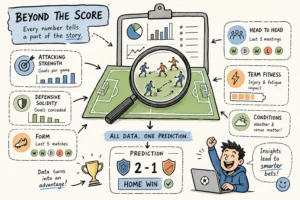
Most casual bettors simply look at a prediction, carry out a quick search on the tip, look at the odds and then place the bet. They skip the most important part: the breakdown. A proper football prediction breakdown will tell you why the tip exists, how certain you can be about the prediction and whether or not there is value in the odds on offer to your stake.
Kcpredict publishes these every day for many leagues but it’s only useful if you understand what they contain. This article will take you through each section of a real match breakdown so you can understand what you’re looking at before you stake your money.
What a football prediction breakdown actually contains
A prediction is not a guess at a result. It’s a structured set of data from various layers that are combined into a prediction. Understanding this structure will allow you to understand what matters most in the breakdown and what isn’t necessary background.
A complete and interesting tip includes a current form section, a head-to-head section, a discussion of venue factors, a discussion of squad availability, the statistical model’s win probability, a comparison with bookmaker odds, and an overall concluding tip. Different layers of analysis alter the probability up or down depending on market and analytic circumstances, and only then is the final tip made.
The tip itself – home, draw, over 2.5 – is the output of analysis, not the analysis itself. If you only read the tip, you’re reading the verdict without the evidence. The breakdown is where you get the real signal, and if you read nothing of it, you can’t judge whether the tip is useful for the bet you’re planning on making.
Form, H2H, and venue: the context every tip is built on
Before calculating any probabilities, analysts dive into the contextual details of the match. Form tables, H2H tables and data, venue factors – these are not decorative touches added to a tip. They’re the variables that form the foundation of all subsequent probability calculations.
Serialist models always apply weight to the last five to ten matches, and recent matches get the heaviest weights. The raw facts of win, loss, draw reflect only part of the story. The real story is in the quality of chances created and allowed, as measured by expected goals (xG), indicating whether a team has maintained its form by computing it or simply letting a superlative finishing streak repeat itself.
A team winning 1-0 consistently from a basis of 0.4 xG per game is not equivalent to a team creating 2.2 xG per game each time. Head-to-head performance has some legacy in the models, but only when a consistent style against that opponent is revealed, such as one team consistently shutting down the other team’s pressure.
Quick changes to squad and manager eliminate most of the predictive power of historic H2H record. This is treated as background detail rather than valuable predictive information. Home advantage is a metric, not a gut feeling. In the big European leagues it can increase a team’s probability of winning by five to nine percentage points, depending on the league and the model.
However, home-team advantage becomes even more important if a team has a considerably worse home and away record; so if you’re the kind who spends a lot of time reading that column in any breakdown, you might want to take a closer look before you place your stake.
Probabilities versus odds: it’s a football prediction math breakdown that most pudders skip
Once all that contextual information is in place, the model produces a probability of each outcome: home win, draw, and away win. This is where the magic of a match-prediction analysis really begins; and where most bettors fade away.
Have you ever wondered why a tipster offered you a home-win tip for odds of 1.60 and it still lost? This section’s all about why the way you’re asking that question is actually the wrong one to be asking.
Model inputs
For modern prediction models it’s common to include team strength ratings, xG from recent matches, lineup information and the home field advantage. Your model might say a team has a 68% chance to beat their opponent. But that does not mean in a single match you will mispredict 3 times out of 10.
Rather, if you were to play 10 matches with the same rating inputs the model would predict the team to win 68% of those matches. Similarly, if you look at any single match the outcome may be uncertain, but in the long run fair odds would be 68% of the time that the team is expected to win.
Fair market probability and stripping overround
Odds are written with a margin built in. Decimal 1.80 odds have 55.6% implied probability. But as a bookmaker the overround in the line pushes the true/trimmed odds down, which is often 52% in the case of football betting markets.
Comparing whether you believe a tip is good is where you decide whether you are good at it. The model’s betting model probability is compared to the trimmed fair market probability of the outcome and not the raw odds. That alone is a disciplined approach to betting.
Model basics and identifying value edge in a football prediction breakdown
Value is the essential element distinguishing betters from gamblers. If the model predicts higher probability of an outcome than the price implied by the bookmaker’s odds, then the tip is valuable. Hence, it is possible that your prediction is exactly right, but a bad bet because its price was too short to compensate for the risk you were taking.
To calculate bet value, simply multiply probability (as a decimal) by the decimal odds. Subtract one and the result is your bet’s value. You have positive value if it’s greater than zero. For instance, if the model assigns a 10-20-70% win-draw-loss split in favor of the home team, that’s a 55% chance of a home win. If the best odds on offer are 2.20, then (0.55 × 2.20) − 1 = +0.21, or 21% value.
Most professional bookmakers suggest a minimum of three to five percent positive edge before you make a bet, after removing the bookmaker’s overround. Good model prediction monitors give each tip a confidence score based on model uncertainty and how big an edge it has.
A high confidence high value edge tip will always take more of your bankroll than a factor of one corner case. Flat one-unit for starters, just let’s see how the number unfolds before scaling stakes.
We walk through an actual match breakdown, from start to finish
Theory applies differently when connected to a real match situation. Here’s what a whole probability-based football prediction looks like in practice, by using a realistic fixture to walk through and illustrate how each of the data layers combines to produce the final recommendation.
Mid-table Premier League home side hosting a top six away side. The home side’s current form shows three wins in five and high xG, while visitors have rotated their squad across a midweek European tie and also are carrying far inferior away xGA. The model’s “flat” home side win probability sits at 42%, increasing to about 48% after we added in the home advantage for the league in question.
Now let’s look at the bookmaker line. If the odds they are offering for a home win are 2.20, that’s a raw implied probability of 45.5%. After you work out the overround, you’re looking at a fair probability of 43.5%. If your model sits at about 48%, that’s about a four or five percentage point edge here in the home team’s favour.
So if you dig into the details, from the stats to the model and there’s no gut-feeling in the tip. There is a worthwhile edge to exploit, if you agree with the numbers. So you can take a look at the numbers. You can question them. This is a data-driven tip with a visible reason behind it. It’s up to you to decide if it works with your game read before you place a bet.
How Kcpredict does this each day manually and automatically
Manually building a full match breakdown takes a lot of time: form data, xG, venue adjustment, odds conversion and value edge analysis. So what’s a lot of bettors lacking is the busywork of those specialised tools and the hours of pre-match research needed to do all of that for a whole set of multiple leagues off the weekend?
Kcpredict publishes the daily match preview that covers everything from form analysis, H2H, venue, to the final recommended bets. Every single recommendation is paralleled with the reasoning that lead to it, so you won’t get handed a pick and no explanation, you will see the argument and can react to it.
If you have a little free time and want to judge how we do our analysis, Kcpredict offers an insight into the analysis approach and the different ingredients used in the model on their platform so you can start creating your own prediction.
The most powerful thing you can do with this data is to use the Kcpredict feed as your starting point, combine it with your own analysis of the lineups and odds movement before the start of the action, upscale it further. You are not delegating all the responsibility to the algorithm, you are just gaining a huge advantage over others. It gets even better if you are betting on multiple fixtures over the weekend.
What you should learn from a football prediction breakdown
A football prediction breakdown is like a very structured argument, not an alchemy or a magic wand. Every single element: form, H2H, model probability, value edge, is somewhere influenced by the data and effort behind inputting the data. You will understand how the predictions have been made and be able to critique them, instead of blindly following the recommendations.
There is this one thing that separates big-time, disciplined, bankroll-growing bettors from part-timers who chase results and blame bad luck. Understanding why a tip is given and whether the odds represent true value is always highly analytical. However, understanding the probability behind each bet takes effort – but it’s worth it. Every bet becomes clear once you are able to understand it’s probability. Whether you’re looking at Asian handicaps, accumulators, or correct-score markets.
Kcpredict downloads and publishes a full game breakdown for each match, each day – that’s the baseline if you’re looking to get that detailed view of the game without having to do all the analysis yourself. Bookmark it and see if the commentary aligns with your own observation of the game.