


Alternative corner lines offer different count thresholds beside the main corner market. They let a forecast be expressed through a lower or higher boundary, with a corresponding price and sometimes a refund condition. Readers using Vebo TV should preserve both the line and its quote. This guide compares available thresholds, examines their payment conditions and connects a choice with a forecast distribution. A lower boundary can include more winning counts without automatically offering better value. Fictional totals illustrate the tradeoff while actual settlement remains tied to the accepted product rules. Both forecast and ticket should use the same corner counting convention.
Alternative Corner Lines Beside The Main Line
Alternative corner lines should be compared within the same contract family. Keep the statistic and period fixed before assessing Vebo.
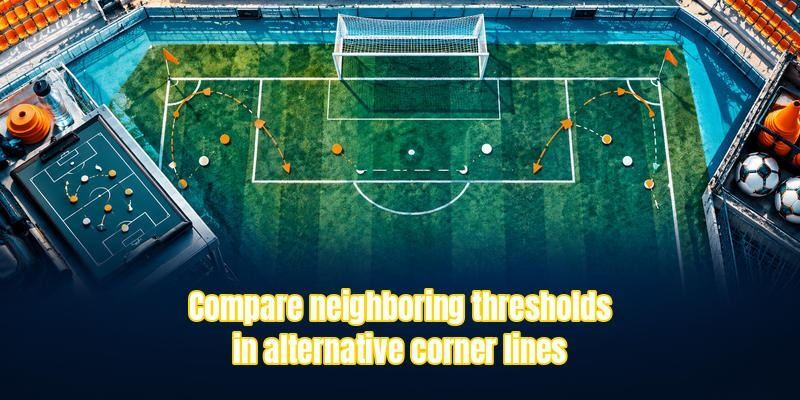
Compare neighboring thresholds in alternative corner lines
Compare Lower And Higher Totals
For a full match total, over 8.5 wins on nine or more qualifying corners, while over 10.5 needs eleven or more. Alternative corner lines change the set of counts that satisfies the selection. Ten corners wins the first ticket but loses the second. Neither threshold describes the selected team's corner count unless the product explicitly says team total. Preserve the market label when copying a comparison into notes.
Separate Match Totals From Team Totals
A Harbor team total above 4.5 needs at least five Harbor corners. A match total above 9.5 needs at least ten combined corners. The two can settle differently even when both concern the same fixture and period. Keep the selected team's distribution separate from the combined distribution. An alternative menu may display several families close together, but neighboring rows are not necessarily thresholds of an identical event.
Check Whole, Half And Quarter Thresholds
Whole, half and quarter lines also change payment boundaries. A whole total of ten can refund at ten under a two way Asian total rule. A half total of 10.5 cannot equal an integer count. A quarter total of 10.25 splits between ten and 10.5. These are contract mechanics, not stylistic ways of writing the same threshold. Read the product's settlement rule before comparing a quoted payment. Totals ask how many qualifying events occur, either combined or for a selected team. Goals and corners are different statistics, while full-match and first-half totals are different periods. A team handicap asks about a margin, so a goal total cannot settle it without knowing the score distribution. Race or first-event products introduce timing as another quantity. Identify whether the contract needs the eventual count or event order. The count window must remain consistent across each comparison row.
Alternative Corner Lines And Their Prices
Alternative corner lines need their associated prices in the same record. A larger decimal number often describes a stricter winning condition, which must be examined directly.

Read the paired prices for alternative corner lines
Read The Price For Each Threshold
Suppose fictional over 8.5 is 1.55, over 9.5 is 1.85 and over 10.5 is 2.20. Alternative corner lines at higher totals require more qualifying corners in these examples. The quote ladder cannot be assessed solely by its largest multiplier. Estimate how often counts reach nine, ten and eleven, then evaluate those estimated chances against the respective payment conditions and relevant costs.
Avoid Comparing Odds Without The Line
Comparing over 8.5 at one provider with over 10.5 elsewhere does not identify the best price for the same event. Match the exact line before comparing quotes. If the purpose is to choose between different thresholds, say so explicitly and show their distinct settlement sets. A contract comparison can use one forecast distribution, but it must account for the outcome boundary and any equality refund in each row.
Estimate A Range Of Plausible Counts
A useful forecast is a range with frequencies or estimated probabilities, rather than a single expected count. Counts concentrated around nine and ten make the difference between 8.5 and 10.5 consequential. Counts concentrated far below both make either over selection difficult to support. Small or mismatched samples can make these estimates unreliable. Document the source period, team split and extreme observations before using a fitted distribution.
An understood threshold gives a clear result after the count is known, but it leaves the forecast uncertain. Football totals betting can be read correctly and still lose because the expected event production never occurs. For a possible selection, document the hypothesis and its main weakness before kickoff. Afterward, ask whether the predicted behavior appeared and whether it converted into the selected statistic. Keep accepted price, stake, count, and net result together. A winning ticket can also arise from unexpected circumstances, so review reasoning separately from payment rather than assume either one success or one loss validates the method.
High possession can involve slow circulation well outside dangerous areas. A distribution estimate should therefore retain its sample size, event convention and uncertainty beside each proposed threshold and available quote.
Selecting A Threshold From The Count Forecast
Alternative corner lines should translate the count forecast into ticket conditions. Test borderline counts because they reveal differences that a large final count may hide.

Match a count forecast to alternative corner lines
Map Counts To Winning Conditions
Write settlement outcomes at eight, nine, ten and eleven corners. For the fictional ladder, nine wins over 8.5 but loses over 9.5 and 10.5. Ten wins the first two and loses the third. Alternative corner lines are easier to interpret with this compact boundary test than by saying one selection is “safer.” That adjective hides both the changed winning set and the lower quoted payment.
If the provider offers an Asian whole team total, equality can push under its rule. Over 5.0 wins above five, pushes at five, and loses below five. A quarter line such as over 4.75 splits into over 4.5 and over 5.0, so exactly five produces one win plus one push. With twelve units at 1.90, the six-unit winning half returns 11.40 and the pushed half returns six, making 17.40 gross and 5.40 profit. Check availability and settlement terms instead of assuming every team-corner product uses Asian split mechanics. The actual product name takes priority over a familiar decimal ending.
Half-point totals create clear thresholds.
Test The Cost Of A Safer Threshold
A lower threshold usually gives up some return multiplier in exchange for covering more counts in a conventional quote ladder. Whether the exchange is attractive depends on the estimated distribution, not on coverage alone. Compare a fixed stake across the alternatives so that a different stake does not obscure the price effect. A high win frequency can still produce poor returns if the price is too short for the actual chance.
Record The Accepted Period And Line
Vebo TV readers should record the accepted threshold, selected side, period and qualifying corner convention. The menu's main line can move after acceptance without rewriting the original ticket. Keep later display changes as observations rather than substitute terms. Review the actual count against the accepted boundary, then assess whether the evidence supported that choice before kickoff. The same method can identify a reason to avoid a threshold when the forecast is too uncertain. Keep the period and count definition with each quarter line calculation for verification.
Conclusion
Alternative corner lines offer different ways to express a count forecast through explicit thresholds. Their prices must be read beside the winning set and any equality refund. Vebo TV readers should compare like periods, separate team totals from match totals and test counts near each boundary. Build a small threshold table for one fictional fixture before selecting a contract. Then review Lịch thi đấu using its original terms. Wider coverage and larger potential return are different features; neither establishes a profitable decision without a defensible forecast and price assessment. Keep nearby counts visible so equality boundaries are easy to verify afterwards.