The 2026 FIFA World Cup begins on June 11 when co-hosts Mexico face South Africa in the tournament opener.
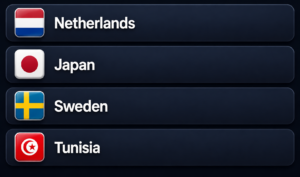
Group F brings together four nations with contrasting football histories and ambitions. The Netherlands arrive as the clear favorites, Japan continues their rise among the global elite, Sweden returns after missing the previous tournament, while Tunisia seeks a long-awaited first appearance in the knockout rounds.
With two established football powers and two dangerous outsiders, Group F could prove one of the most competitive sections in the tournament.
Group F overview
-
Netherlands – three-time runners-up, ranked 7th
-
Japan – Asia’s highest-ranked side, ranked 18th
-
Tunisia – regular African qualifiers, ranked 45th
-
Sweden – returning after missing 2022, ranked 38th
NETHERLANDS
Tournament profile
The Netherlands remain one of football’s great World Cup stories.
Despite reaching three finals in 1974, 1978, and 2010, the Dutch have never lifted the trophy. Their appearance in North America will be their 12th at the finals, and they arrive once again among the leading contenders.
Having reached the quarter-finals in Qatar and the semi-finals of Euro 2024, expectations are high for another deep run.
Qualification journey
Ronald Koeman’s side navigated qualification unbeaten.
The Dutch recorded victories home and away against Finland, Malta, and Lithuania, while drawing both matches against Poland to finish top of their group.
They scored 27 goals and conceded only four, underlining their balance at both ends of the pitch. Qualification was secured with a comfortable victory over Lithuania in Amsterdam.
Key player
Virgil van Dijk remains the cornerstone of the Dutch side.
The captain continues to provide leadership, defensive authority, and experience at the highest level. While the Netherlands possess attacking talent throughout the squad, Van Dijk’s ability to organize the defense and influence matches in both penalty areas makes him indispensable.
Tactical outlook
The Netherlands combine defensive stability with attacking versatility.
Koeman has options across every area of the pitch, allowing the team to adapt to different opponents and match situations. Their balance between experience and technical quality makes them one of the most complete sides in the tournament.
Assessment
The Dutch enter Group F as clear favorites and will expect to progress as group winners.
Anything less than a quarter-final appearance would likely be viewed as a disappointment.
JAPAN
Tournament profile
Japan continues to establish themselves as one of the most consistent teams in international football.
Since making their World Cup debut in 1998, they have qualified for every tournament and reached the Round of 16 on four occasions. Their next objective is clear: winning a knockout match for the first time.
Qualification journey
Japan were among the earliest nations to secure qualification.
After a flawless second-round campaign, they topped a difficult final qualifying group that included Australia and Saudi Arabia.
Their qualification run was characterized by defensive discipline, attacking efficiency, and consistency across the squad.
Key player
Ayase Ueda enters the tournament following the strongest season of his career.
The striker’s goalscoring exploits in the Eredivisie have elevated his profile, and Japan will look to him for decisive moments in front of goal.
His movement and finishing ability provide a focal point for an otherwise collective team approach.
Tactical outlook
Japan’s greatest strength remains their organization.
Rather than relying on individual stars, they function as a cohesive unit built around technical quality, intelligent movement and tactical discipline. They are comfortable both in possession and when playing on the counter-attack.
Assessment
Japan are a genuine contender to progress from the group and have the quality to challenge the Netherlands for the top spot.
A place in the knockout rounds should be the minimum target.
SWEDEN
Tournament profile
Sweden returns to the World Cup after missing Qatar 2022.
Their football history includes a runners-up finish on home soil in 1958 and third-place finishes in 1950 and 1994. This will be their 13th appearance at the finals.
Qualification journey
Sweden took an unconventional route to North America.
They struggled through qualifying and changed managers midway through the campaign before securing a play-off place through Nations League performances.
Victories over Ukraine and Poland ultimately sealed qualification.
Key player
Viktor Gyokeres arrives as Sweden’s most influential attacking weapon.
The striker played a decisive role during the play-offs and has developed into one of Europe’s most dangerous forwards. His partnership with Alexander Isak gives Sweden one of the strongest attacking pairings in the group.
Tactical outlook
Under Graham Potter, Sweden are seeking greater balance between defensive structure and attacking creativity.
The side possesses considerable firepower but remains vulnerable in certain defensive areas, particularly against technically gifted opponents.
Assessment
Sweden have enough quality to compete for qualification, but consistency will determine whether they progress.
Their opening match against Tunisia could prove decisive.
TUNISIA
Tournament profile
Tunisia arrive at their seventh World Cup still chasing a historic first appearance in the knockout stages.
The North Africans have become regular participants in recent decades but have repeatedly fallen short of progressing beyond the group phase.
Qualification journey
Tunisia were dominant throughout African qualifying.
They won nine matches, drew one, and remarkably did not concede a single goal during the campaign. Qualification was secured comfortably, highlighting the defensive foundations of the team.
A coaching change followed qualification, with Sabri Lamouchi taking charge ahead of the finals.
Key player
Captain Ellyes Skhiri is the heartbeat of the Tunisian midfield.
The experienced midfielder provides leadership, positional discipline, and tactical intelligence, helping maintain the structure that has become Tunisia’s trademark.
Tactical outlook
Tunisia prioritizes organization, defensive compactness, and patience.
Breaking them down is rarely straightforward, but a lack of goals remains their biggest concern against stronger opposition.
Assessment
Tunisia are capable of frustrating every team in the group, but turning draws into victories will be crucial if they are to make history.
GROUP OUTLOOK
Group F appears set to revolve around the battle between the Netherlands and Japan for first place.
The Dutch possess the strongest squad and the deepest tournament experience, while Japan continues to close the gap on the world’s leading nations.
Sweden have enough attacking quality to challenge for qualification, particularly through Viktor Gyokeres and Alexander Isak, while Tunisia’s defensive resilience makes them dangerous opponents capable of disrupting expectations.
The margins are likely to be fine, but the Netherlands and Japan enter the tournament as the teams most likely to emerge from Group F and reach the knockout stages.